
In the world of events, first impressions matter. From conferences and trade shows to corporate meetings and networking events, the registration and check-in process sets the tone for attendees. One of the most important pieces of that process is the custom event badge. Badges serve as identification, but they also carry your branding, support networking, and signal how well the event is organized.
Event badge printing has changed considerably. On-site badge printing now lets planners produce custom event badges quickly without giving up print quality. Understanding your options, and the trade-offs of each, shapes how smoothly check-in runs.
This guide covers the three main approaches to printing event badges, compares their advantages, and shows when on-site direct thermal printing is the right call.
Why event badges matter: branding, networking, and attendee experience
Before comparing printing options, it helps to be clear on what badges actually do for an event.
- Identity and security: Attendees, staff, and exhibitors are identified at a glance.
- Networking tool: Personalized event badges make introductions easier.
- Branding opportunity: A badge is a portable piece of marketing that carries your event's visual identity wherever the attendee goes.
- Professionalism: Well-designed badges signal that the event is well run.
Badges are more than a name on cardstock. Add personal information and you have a practical tool for connection, recognition, and a better attendee experience.
The three options for event badge printing
Event planners have three main approaches to printing custom event badges. Each offers different levels of efficiency, flexibility, and control. Choosing the right method streamlines check-in, reduces errors, and keeps the first impression clean.
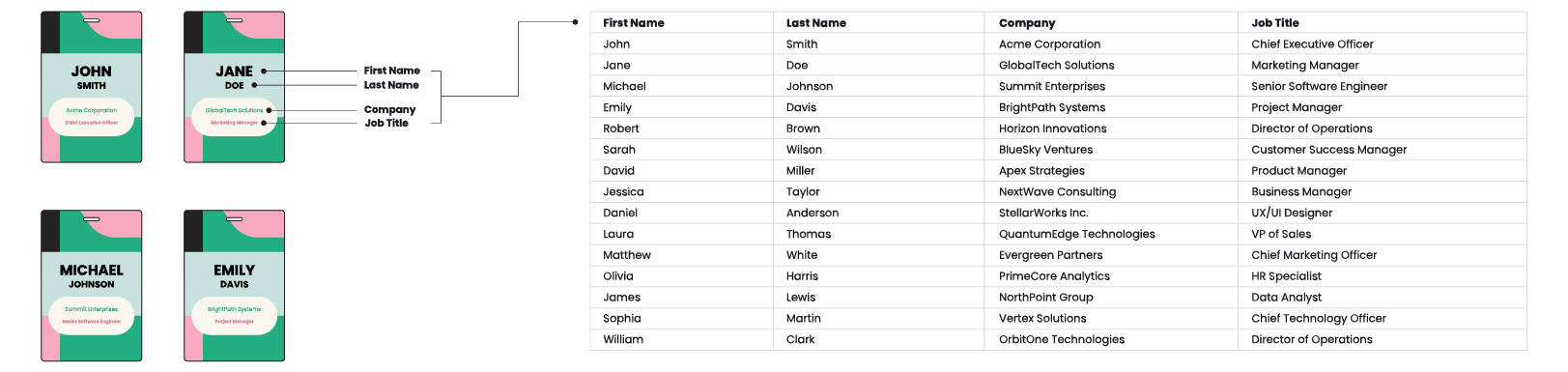
Option 1: Pre-print attendee information before the event
This option means working with a vendor to print every attendee name and detail before the event begins. By the time you arrive on-site, the badges are ready to hand out.
The pros:
- No on-site equipment: Nothing to set up or troubleshoot at the venue.
- No technical risk during check-in: Print failures cannot happen if nothing is printing.
- Faster handout: Everything is pre-printed and ready to grab.
The trade-offs:
- Less flexible: If an attendee's details change or someone registers late, you cannot update the badge.
- Risk of waste: No-shows and cancellations leave unused badges behind.
- Requires accurate forecasting: You have to commit to your headcount well before the event.
Best for: Smaller, tightly controlled events where registrations are finalized well in advance. Learn more about our pre-printed names solution.
Option 2: Print all attendee information on-site at check-in
Print attendee information instantly at the desk with a direct thermal printer. It is one of the most reliable approaches to event name badge printing.
How it works: Controlled heat activates special badge stock to produce sharp text, graphics, and barcodes, with no ink, toner, or ribbons required. The result is fast, low-maintenance printing well suited to high-volume events.
These printers produce durable badges that resist smudging, at speeds that keep lines moving. They are compact enough to fit a crowded registration table.
The pros:
- Flexible and adaptable: Handles last-minute changes, walk-ins, and registration corrections on the spot.
- Zero badge waste: You only print badges for people who actually show up.
- Professional finish: Crisp, clear text and graphics on every badge.
- Real-time efficiency: Live printing tied directly to your registration system.
The trade-offs:
- On-site equipment required: Printer hardware and technical setup at the venue.
- Trained staff or vendor support: Someone needs to manage printers and software during the event.
- Higher initial investment: Equipment costs more upfront than the pre-print approach.
Best for: Medium to large events, especially those with walk-in attendees or last-minute changes. Our direct thermal event badges are made for this workflow, and some planners pair them with an event tech solution to manage printing.
Option 3: Hybrid approach (most common)
The hybrid approach combines pre-printing badges for known attendees with direct thermal printing for last-minute registrants or updates. Planners typically pre-print badges with all available attendee information, then complete the rest on-site, printing directly on paper badges or adding stickers to plastic badges with a direct thermal printer.
The pros:
- Reduced on-site workload: Most badges are already done, so you only print the few that changed.
- Safety net for surprises: Late registrations, name changes, and walk-ins are all covered.
- Balanced cost and convenience: The speed of pre-printing without losing on-site flexibility.
The trade-offs:
- Flexible planning required: You still need to account for no-shows among pre-printed attendees.
- Two workflows to manage: Both pre-print and on-site printing need coordinating.
- Careful organization: A well-coordinated check-in takes more upfront prep.
Best for: Large-scale events where most attendees are confirmed but last-minute sign-ups are expected. When ordering, order the total amount needed and let us know during approval that you want some left blank for walk-ins. Learn more.
Choosing a direct thermal printer for event badges
Direct thermal printers print attendee information instantly at the desk, which is what makes them the workhorse of conference name badge printing.
The Zebra ZD621 series is a common choice for event use. Here is what to look for in any direct thermal printer you consider:
- Reliability: Built for sustained use in fast-paced environments, not occasional office printing.
- Print quality: 300 dpi produces sharp text and clear variable data at badge size.
- Ease of use: Compact and simple enough that non-technical staff can run it.
- Speed: Enough throughput to handle your peak arrival window without a queue forming.
- Integration: Compatibility with your registration platform, so printing is driven by check-in rather than manual entry.
Whichever printer you choose, pairing it with the right direct thermal badge stock is what determines the finished result.
Tips for streamlined badge printing
A few practices that make on-site badge printing run smoothly.
- Integrate registration software: Your registration platform should connect cleanly to your printer.
- Design with branding in mind: Use custom event badges to carry logos, event colors, and sponsor branding.
- Plan for walk-ins: Always have a system for printing badges for last-minute attendees.
- Test equipment ahead of time: Run test prints before the event to avoid day-of surprises.
- Train your staff: Make sure your team can troubleshoot printer issues and manage check-in lines.
- Backup supplies: Keep spare badge stock, lanyards, and clips on hand.
- Consider sustainability: Look into eco-friendly badge materials and recyclable options to reduce waste.
Tips for a smooth check-in experience
Badge printing is one part of the bigger picture. A few more practices that create a welcoming check-in.
- Layout matters: Arrange your check-in area to minimize congestion and confusion.
- Clear signage: Direct attendees to the right line, whether pre-registered, walk-in, or VIP.
- Friendly staff: A warm welcome goes a long way toward setting the tone.
- Digital integration: Offer QR code scanning or digital check-in to reduce wait times.
- Accessibility: Check-in and badge pickup areas should be accessible to every attendee.
A smooth check-in, supported by efficient conference name badge printing, creates a positive first impression and sets the tone for the entire event.
Which approach is right for your event?
Choosing a badge printing method is one of the more consequential planning decisions. Pre-printing works well for smaller, tightly structured gatherings. The hybrid approach offers the most flexibility for medium and large events. On-site printing with a direct thermal printer gives you the most adaptability for high-volume environments with heavy walk-in traffic.
Whichever you choose, the right tools and solid event management practices let you build a check-in that reduces stress for your team and starts the event well for everyone else.
Browse badges Contact us about event badges
Frequently asked questions
Should I pre-print badges or print them on-site?
Pre-print when your attendee list is final well before the event and walk-ins are unlikely. Print on-site when you expect late registrations, name changes, or walk-up traffic. Most medium and large events use a hybrid of both, pre-printing confirmed attendees and leaving blank stock for the rest.
How does direct thermal badge printing work?
Direct thermal printing uses controlled heat to activate specially coated badge stock, producing text, graphics, and barcodes without ink, toner, or ribbons. Fewer consumables means less to run out of mid-event and less maintenance during a busy check-in window.
What is the main drawback of pre-printed badges?
Pre-printed badges cannot be changed once they are produced. Late registrations, corrected names, and title changes all require a workaround on-site, and no-shows leave printed badges unused. Accurate headcount forecasting matters more with this approach than any other.
How many badges should I order for a hybrid setup?
Order your full expected headcount and ask your printer to leave a portion of the stock blank for walk-ins and late changes. At Billy's Badges, you can flag this during the proof approval stage so the blank allocation is built into your order.
What badge stock works with a direct thermal printer?
Direct thermal printers require heat-activated badge stock, which is coated specifically for this process. Standard paper or cardstock will not produce an image. Ordering stock made for direct thermal printing is what gives you sharp, smudge-resistant results.