
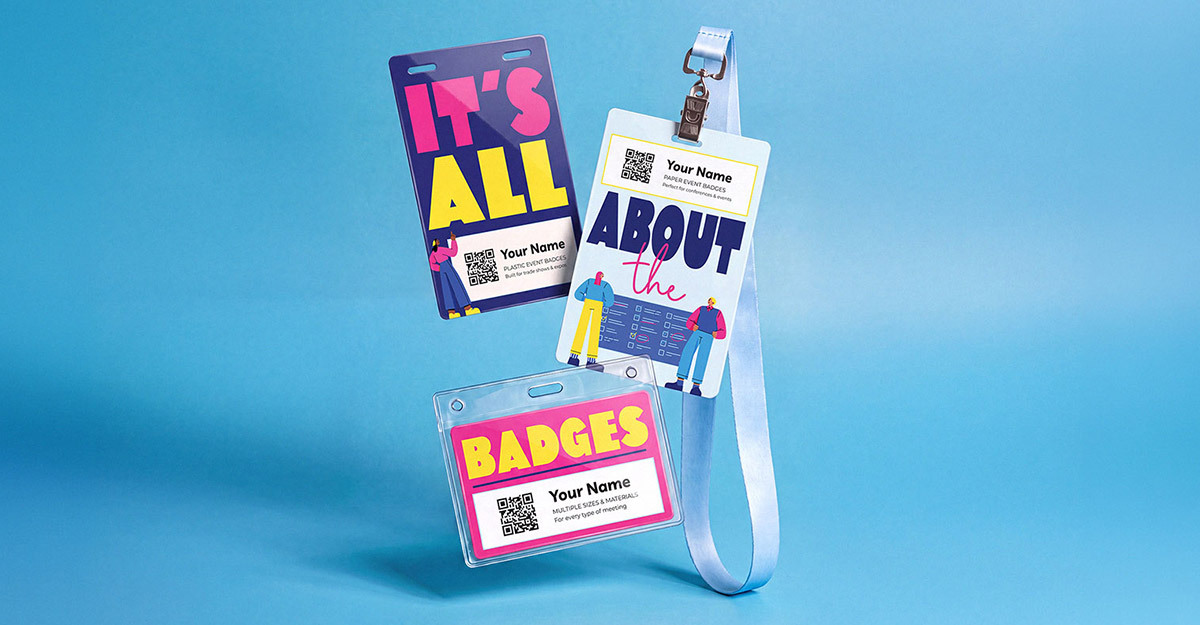
The right badge stock comes down to two questions: when do you know your attendees' names, and who is doing the printing? If names are locked weeks out, pre-printed paper or plastic badges arrive ready to hand out. If registrations keep coming in until doors open, direct thermal badge stock lets your team print each name on-site, in seconds, on your own thermal printer. This guide breaks down all three options and the printer setup each one needs.
Quick answer: match the stock to your registration timeline
| Badge stock | Names printed | Printer needed | Best for |
|---|---|---|---|
| Direct thermal | On-site, at check-in | Yes, a direct thermal printer | Walk-ins, late registrations, software-driven check-in |
| Paper (18 pt cardstock) | Pre-printed before shipping | No | Conferences and corporate events with a final attendee list |
| Plastic (30 mil PVC) | Pre-printed before shipping | No | Multi-day events, festivals, and outdoor or high-wear settings |
Direct thermal badges: print names on-site
Direct thermal event badges split the work in two. Billy's Badges prints your full-color branding (logo, colors, sponsor art) onto the badge stock ahead of time and ships it as a fanfold stack. At the event, your thermal printer adds each attendee's name in black as they check in. No ink, no toner, no ribbon: the printer uses heat to darken the badge's coated surface.
- Handles walk-ins: Anyone who registers the morning of still gets a professional, branded badge instead of a handwritten sticker.
- Works with check-in software: Most event registration and check-in platforms print badges on demand when an attendee scans in or is searched at the desk.
- No reprints for name changes: A misspelled name or last-minute substitution is fixed at the desk, not with a new order.
- Two sizes: 4x6 and 4x3, with notch options to match your badge holders and lanyards.
Heads up: Direct thermal printing reacts to heat, so badges can darken or fade with prolonged sun or high temperatures. For outdoor events or badges that need to last several days in the elements, plastic is the safer pick.
What printer do direct thermal badges need?
Direct thermal badges run on a 4-inch desktop direct thermal printer that accepts fanfold media. The Zebra ZD421d and ZD621d are two of the most common models at registration desks; both print direct thermal media and support fanfold stock up to roughly 4.25 inches wide, which fits a 4-inch badge. Before you buy or rent, check these points:
- Your check-in platform: Confirm which printer models and drivers your registration software supports. This matters more than any spec sheet.
- Resolution: 203 dpi is standard for names and simple QR codes; 300 dpi gives crisper small text and dense codes.
- Connectivity: USB works for a single laptop station; Ethernet or Wi-Fi makes it easier to run several stations from one system.
- Thermal transfer models: Many thermal transfer printers can also print direct thermal stock when run without a ribbon. Check your model's settings before you assume.
- Notch sensing: Notched badges help the printer find the start of each badge. Run a test batch so your printer is calibrated to your stock before doors open.
- A backup: If one printer jams during peak check-in, a spare keeps the line moving.
Pro tip: Order free sample badges and run them through your exact printer and check-in software weeks before the event. A five-minute test catches alignment and driver issues while there is still time to fix them.
Paper badges: pre-printed and ready to wear
Paper event badges are printed on 18 pt cardstock with full-color, edge-to-edge graphics on one or both sides. Upload your attendee spreadsheet and every badge arrives with names, titles, companies, and even per-attendee QR codes already printed. Your team only has to alphabetize and hand them out.
- No printer, no setup: Nothing to rent, calibrate, or troubleshoot at the registration desk.
- Full color everywhere: Names can be printed in brand colors and fonts, not just black.
- Sturdy without lamination: The 18 pt stock is thick enough to resist tearing through a full conference day.
- FSC-certified: A strong fit for events with sustainability goals.
- Room for late registrants: Order more badges than names on your list, and the extras print with your branding and a blank name area.
Production takes 5 business days after you approve your digital proof, plus shipping, so paper works best when your attendee list closes at least a week or two before the event.
Plastic badges: built for multi-day wear
Plastic event badges are printed on rigid 30 mil PVC with a smooth, high-definition finish. Like paper, they arrive pre-printed with names and QR codes, so no printer is needed on-site. The difference is durability: plastic holds up to rain, sweat, and days of being clipped, unclipped, and tossed in a bag.
- Multi-day events: Badges still look sharp on day four of a convention or festival.
- Outdoor and high-wear settings: Water-resistant and rigid, without relying on a holder for protection.
- Access credentials: A substantial feel suits staff, VIP, crew, and all-access passes.
- Size range: 4x6, 4.25x6, 3.5x5.5, 4x3, and CR80 (credit card size).
How do paper and plastic badges handle walk-ins?
Pre-printed doesn't mean locked out of late registrations. When you order paper or plastic badges, set your quantity above the number of names on your list, and the extras arrive with your full branding and a blank name area. At the event, your team prints walk-in names on clear labels and applies them to the blank badges on-site. The badge design shows through the clear label, so a walk-in's badge still looks like it belongs with the rest.
You can also mix stocks by role: paper for general attendees and plastic for staff and exhibitors who wear their badges all week. Keep the same artwork and color-coding across both so every badge reads as part of one event.
How to choose in three questions
- Will names change after your order deadline? If yes, direct thermal (or a direct thermal backup) is the safest route.
- Do you have, or want to manage, a printer at the event? If no, choose paper or plastic.
- How long and how hard will badges be worn? One or two indoor days point to paper; multi-day, outdoor, or high-wear events point to plastic.
Pick the stock that fits your timeline, test it before the event, and every attendee walks away from check-in with a badge that looks like it was planned for them.
Frequently asked questions
What is direct thermal badge stock?
Direct thermal badge stock is heat-sensitive badge material that a thermal printer marks without ink, toner, or ribbon. Billy's Badges pre-prints your full-color branding on the stock, and your printer adds each attendee's name in black at check-in.
Does Billy's Badges print badges at my event?
No. Billy's Badges produces and ships custom badges. Paper and plastic badges arrive with names pre-printed, and direct thermal badge stock is designed for you to print names on-site with your own compatible thermal printer.
Which printers work with direct thermal event badges?
Most 4-inch desktop direct thermal printers that accept fanfold media work, such as the Zebra ZD421d and ZD621d. Always confirm compatibility with your check-in software provider, and test sample badges in your printer before the event.
Do I need a printer for paper or plastic badges?
Not for registered attendees. Paper and plastic badges are printed by Billy's Badges with names, titles, and QR codes from your attendee spreadsheet, then shipped ready to hand out. For walk-ins, order extra blank-name badges and print names on clear labels on-site to apply to the badge.
Can direct thermal badges be used outdoors?
For short outdoor stints, yes, but heat and direct sun can darken or fade direct thermal printing over time. For outdoor or multi-day events, plastic badges are more durable.
How long does it take to get badges?
Badge production is typically 5 business days after you approve your digital proof, plus shipping. Rush production is available at no extra charge; faster shipping costs more.