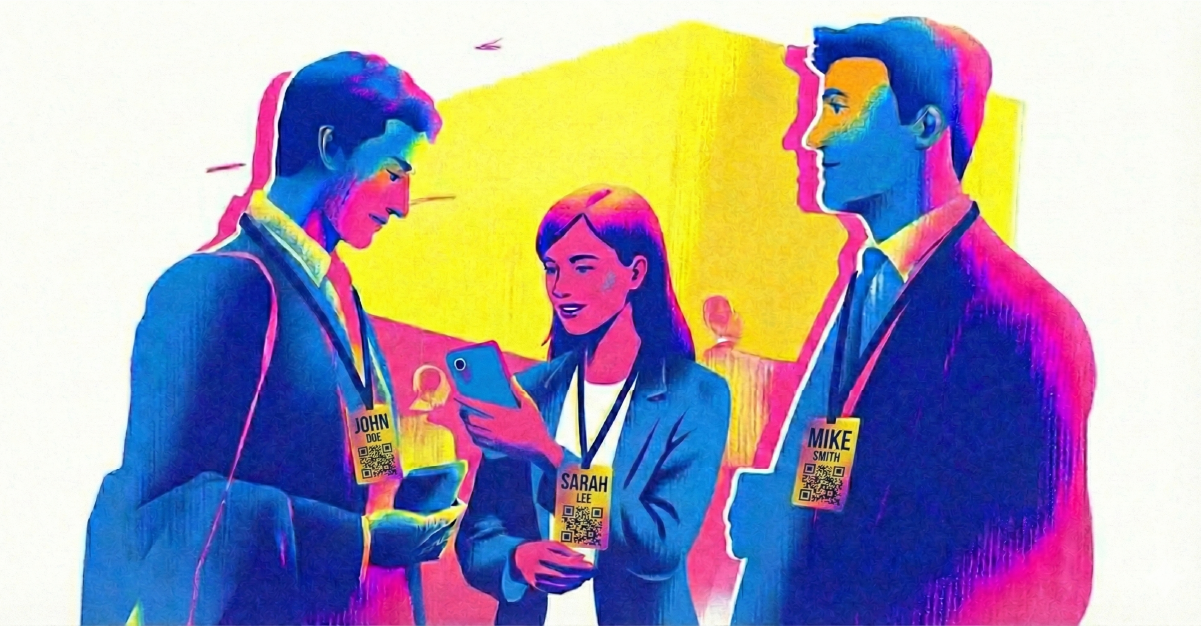
Lead retrieval is how exhibitors capture attendee contact details at a trade show by scanning the data encoded on each attendee's badge. Instead of collecting business cards or typing names into a spreadsheet, booth staff scan a QR code, barcode, or NFC chip, and the attendee's information drops straight into a lead list ready to export to a CRM. This guide explains how the scan works, the badge technologies behind it, the options exhibitors have, and how badge design affects whether the scan lands cleanly.
How lead retrieval works
Lead retrieval connects three things: the attendee's badge, a scanning device, and the show's registration database. The flow runs in order:
- The attendee registers, and the show encodes their contact record behind a unique ID.
- That ID is printed or embedded on the badge as a QR code, barcode, or NFC chip.
- Booth staff scan the badge with a handheld device or a phone app.
- The scan pulls the attendee's details from the show database into the exhibitor's lead list.
- Staff qualify the lead on the spot with notes, ratings, or follow-up flags.
- After the show, the leads export to the exhibitor's CRM or email tool.
The badge technologies behind the scan
Every lead retrieval system depends on the badge carrying machine-readable data. Three technologies do this, and many shows support more than one:
- QR code: A 2D square scanned by a camera or phone app. It holds a URL or attendee ID and is the most widely supported format because almost any phone can read it.
- Barcode: A 1D or 2D code read by a laser scanner or app. Reliable and inexpensive to print, and a long-standing standard at larger shows.
- NFC: A contactless chip embedded in the badge that transfers data on a tap. Fast and frictionless, though it requires NFC-enabled badges and readers.
For a deeper look at how these formats are added to a badge, see RFID, NFC, QR, and barcode badges.
Lead retrieval options for exhibitors
Exhibitors usually choose from three approaches, each with a different cost and control trade-off:
- Show-provided scanners: Handheld devices rented from the event organizer. Guaranteed to work with that show's badges, but they carry a rental fee and only work at that event.
- App-based capture: A phone or tablet app that scans the badge code. Lower cost and easy to hand to every booth staffer, though it depends on the show supporting an open format.
- Universal lead capture: Third-party tools that work across multiple shows and feed a single CRM. Useful for exhibitors who work a full season of events.
What data you capture, and what you do not
A scan typically returns the attendee's name, company, job title, and the contact details they agreed to share at registration, plus any qualification notes your staff add. It will not return data the attendee opted out of sharing, and consent rules vary by region, so treat the scan as a permission to follow up, not a blanket contact grab. Confirm the show's data-sharing terms before the event so your follow-up stays compliant.
Design badges that scan cleanly
A lead retrieval system is only as good as the badge it reads. Codes that are too small, low-contrast, or crowded slow the line and cause misreads. When you produce your badges, build the code in properly:
- High contrast: Dark code on a light background reads fastest; avoid printing codes over artwork or color.
- Quiet zone: Leave clear space around the code so the scanner can find its edges.
- Consistent placement: Put the code in the same spot on every badge so staff know where to aim.
- Adequate size: Size the code for a quick scan at arm's length, not a phone held an inch away.
- Test before the run: Scan a proof with the actual device or app before printing the full order.
Variable-data printing places a unique QR or barcode on every badge straight from your attendee CSV, so each code maps to the right person. Order direct thermal event badges built to carry clean, scannable codes.
Keep reading
- RFID, NFC, QR, and barcode badges explained
- Trade show booth staffing: how to plan your on-site team
- Multi-day event logistics: how to plan a multi-day conference
Clean, scannable badges are what turn a busy booth into a full lead list, so the technology behind the scan starts with the credential in the attendee's hand.
Browse event badges Get a sample pack
Frequently asked questions
What is lead retrieval at a trade show?
Lead retrieval is how exhibitors capture attendee contact details by scanning the data encoded on each attendee's badge, using a QR code, barcode, or NFC chip. The scan pulls the attendee's information from the show's registration database into the exhibitor's lead list, replacing business cards and manual data entry.
How does badge scanning work for lead capture?
Each attendee's badge carries a unique ID as a QR code, barcode, or NFC chip. When booth staff scan it with a handheld device or phone app, the scan pulls the attendee's contact record from the show database into a lead list. Staff can add qualification notes on the spot, then export the leads to a CRM after the event.
Do you need special badges for lead retrieval?
You need badges that carry a machine-readable code: a QR code, a barcode, or an embedded NFC chip. The code must be high-contrast, correctly sized, and placed consistently so scanners read it quickly. Variable-data printing adds a unique code to every badge from your attendee list, which is what maps each scan to the right person.
What is the difference between QR, barcode, and NFC lead retrieval?
QR codes are 2D squares read by a camera or phone app and are the most widely supported. Barcodes are read by a laser scanner or app and are a reliable, inexpensive standard at larger shows. NFC uses a contactless chip that transfers data on a tap, which is fast but requires NFC-enabled badges and readers.
Can exhibitors export leads to a CRM?
Yes. Most lead retrieval systems let exhibitors export captured leads, along with any qualification notes, to a CRM or email tool after the show. Universal lead capture tools go further by feeding a single CRM across multiple events, which suits exhibitors who work a full season of shows.