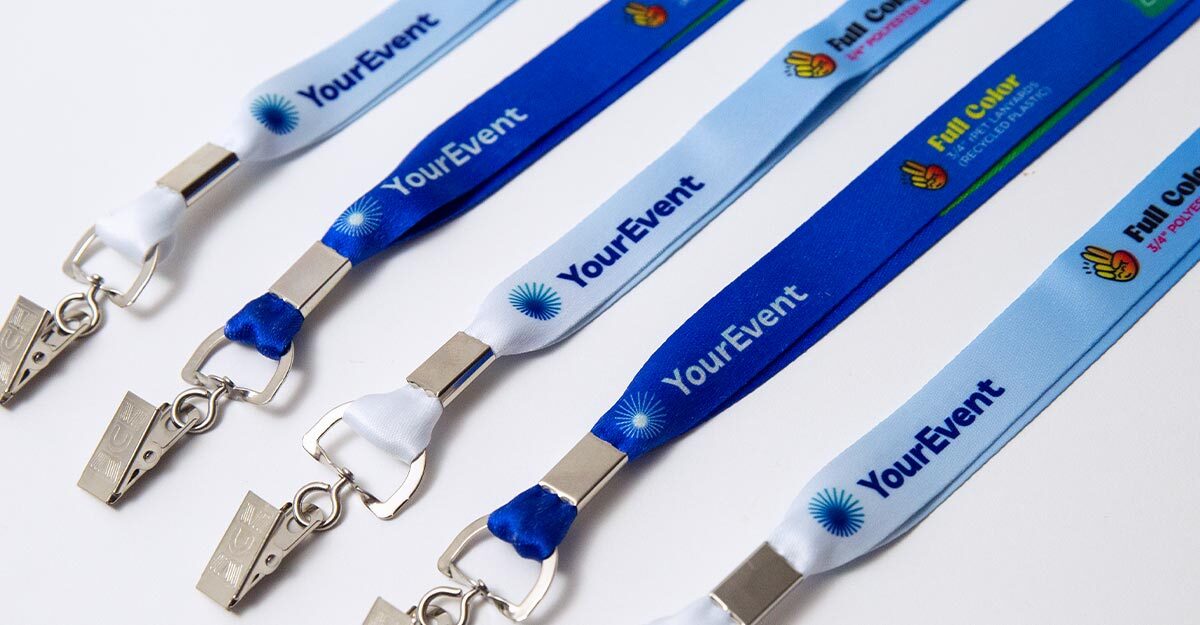
A lanyard is the cheapest piece of branded real estate at your event, and the one attendees wear for every hour of it. Custom badge lanyards decide whether your badge hangs straight or spins backward, whether a name is readable across a handshake, and whether your logo shows up in every photo taken on the floor. This is the spec guide: widths, materials, attachments, and how to pair a lanyard with the badge size you already ordered.
What counts as a custom badge lanyard
A custom badge lanyard is a neck strap printed with your artwork and finished with an attachment that holds a badge or badge holder. Three decisions define it:
- Width: How much printable surface the strap gives you, and how much weight it carries comfortably.
- Material: What the strap is woven from, which drives both the look of the print and the sustainability story.
- Attachment: The hardware at the bottom that connects to the badge, which determines whether the badge stays facing forward.
Personalized badge lanyards add a fourth layer: variation within the order. Instead of one artwork across every strap, you run different colors or printed text by attendee role, so the lanyard itself communicates access level before anyone reads the badge.
Lanyard widths and what each one is for
Billy's Badges offers custom lanyards in three widths. The right one is mostly a function of badge size and how much artwork you need to fit.
| Width | Best for | Artwork capacity |
|---|---|---|
| 5/8 inch | Credit-card and mini badges, staff and crew credentials, budget-conscious large runs | Logo or short repeating text, one or two colors reads best |
| 3/4 inch | The default for conference badges and lanyards, including 4x6 and 3.5x5.5 badges | Logo plus tagline, sponsor mark, or event name and year |
| 1 inch | Large-format badges, sponsor-funded lanyards, premium and VIP tiers | Full-color artwork, multiple logos, photographic backgrounds |
If you are choosing between two widths, go wider. A 3/4 inch strap under a 4x6 badge sits better and reads cleaner from across a room than a 5/8 inch strap doing the same job, and the per-unit difference is small relative to what you are spending on the badge itself.
Materials: polyester and recycled rPET
Polyester is the workhorse. It holds print sharply, resists wrinkling through a multi-day event, and survives being stuffed into a tote bag and pulled back out. Recycled rPET is woven from post-consumer plastic and behaves nearly identically in the hand, which makes it the straightforward swap when you have a sustainability commitment to report against.
- Polyester: Sharpest print reproduction, widest color range, the default for full-color artwork.
- Recycled rPET: Comparable durability and print quality, with a diverted-plastic story you can put in the program.
For a closer look at how the two compare on feel, print fidelity, and end-of-event disposal, see our deep dive on polyester and recycled lanyards, and the full list of our eco-friendly options on the sustainability page.
Attachments and why badges spin
The attachment is the spec most planners skip and most attendees notice, because it is what decides whether a badge faces forward or presents its blank back to the room all day.
| Attachment | How it behaves | Best for |
|---|---|---|
| Bulldog clip | Strong grip on a slotted badge or holder, single connection point so the badge can rotate | General attendee badges, lightweight paper stock |
| Lobster claw | Snaps on and off easily; single connection point, so the badge can rotate | Single notch badges and holders |
| Swivel J-hook (special order) | Rotates at the hardware instead of twisting the strap, easy for attendees to clip themselves | Self-service badge pickup, badge holders with a punched slot |
| Double bulldog or double lobster claw | Two connection points, which is the only reliable fix for a badge that will not stay forward | Large 4x6 badges, sponsor-facing events, anything being photographed |
Pro tip: If your badge has a printed back (agenda, map, Wi-Fi password, sponsor grid), a single-point attachment is fine, the flip is a feature. If the back is blank, specify a double clip. A 4x6 badge on one hook will end up backward within an hour, and every photo from your event will show a blank white rectangle where your logo should be.
Matching the lanyard to your badge size
Lanyard and badge get ordered as a pair, or at least they should be. About 80 percent of the badges we print are 4x6 portrait, outselling 4x3 by roughly four to one, which makes 3/4 inch the width we recommend most often.
| Badge size | Recommended width | Attachment note |
|---|---|---|
| 4x6 portrait | 3/4 inch or 1 inch | Double clip if the badge back is blank |
| 3.5x5.5 | 3/4 inch | Single clip is usually stable at this size |
| 4x3 | 5/8 inch or 3/4 inch | Bulldog clip or lobster claw both work |
| 2.125x3.375 mini | 5/8 inch | Keep the hardware light so the badge hangs straight |
If you are pairing lanyards with a clear badge holder rather than attaching to the badge directly, check the holder's slot orientation before you order hardware. Holders punched for a horizontal slot and a double hook need a different specification than a single center punch.
Custom name badges and lanyards as one system
Ordering custom name badges and lanyards together is not just a purchasing convenience, it changes what the credential can do. Ordered together, you can carry a single design system across them and use color as an access signal that staff can read at a glance.
- Color-code by role: One lanyard color per tier, attendee, speaker, exhibitor, staff, press. Door staff learn the colors in a minute and stop squinting at badge text.
- Keep the type legible: Names should read from about six feet. That means a large first name, a smaller organization line, and nothing important in the bottom inch where a hand covers it.
- Leave room for ribbons: If you use achievement or role ribbons, plan the badge layout so they attach without covering the name.
- Order overage: We typically see people order around 10% extra, but it really depends on the event. Walk-ins, spoiled prints, and name corrections all draw from the same pool.
Personalized badge lanyards: when a separate design per role is worth it
Role-based lanyards carry a role or track name on the strap itself. Each role version is its own design, with its own minimum, so it earns its cost in specific situations rather than as a default.
- Multi-track conferences: Printing the track on the lanyard helps attendees find their own sessions and helps your staff route them.
- Tiered access: When access control matters more than aesthetics, a printed word beats a color that gets mistaken under warm venue lighting.
- Sponsor tiers: A sponsor-branded lanyard for their delegation is a straightforward add to a sponsorship package.
For most single-track events, a color-coded lanyard paired with role text printed on the badge does the same job for less. Put the variable data where it is cheapest to change, which is the badge.
Lead times and how to plan the order
Custom lanyards run 10 to 12 business days after proof approval, plus transit time. Two details matter in that sentence: the clock starts at approval, not at order, and shipping is on top.
- Budget for the proof round: Build in a few days for artwork review and one revision cycle before the production clock starts.
- Send print-ready art: Vector logo files, spot colors specified, and text converted to outlines. This is where most proof delays originate.
- Order by role, not by guess: Pull final counts per tier from your registration data rather than estimating the split.
- Keep a rush path open: Blank lanyards in a brand-adjacent color are the reliable fallback when a count changes late or a walk-in wave arrives.
Heads up: The most common late-stage lanyard problem is not production, it is counts. Registration climbs in the final two weeks, after your lanyard order has already been approved and printed. Order against your projected final headcount plus overage, not the number on the dashboard the day you place the order.
Spec sheet: what to confirm before you approve
- Width: 5/8, 3/4, or 1 inch, chosen against badge size.
- Material: Polyester or recycled rPET.
- Print: Artwork, and whether it repeats down the full strap or prints once.
- Attachment: Single or double clip, matched to badge weight and whether the back is printed.
- Safety release: Breakaway clasp specified where required, which is standard practice for events with minors or in industrial venues.
- Quantity: Final count per color or role, plus your overage.
- Dates: Proof approval deadline working backward from your in-hand date, with shipping transit included.
Free sample packs include lanyards alongside badges and holders, which is the fastest way to settle a width or material debate. Hold the options against your actual badge stock before committing to a full run.
Specify the width, material, and attachment deliberately and you get a credential that hangs straight, reads clearly, and carries your brand through every hour of the event.
Get a sample pack Shop custom lanyards
Frequently asked questions
What width should a custom badge lanyard be?
Three-quarter inch is the right default for conference badges and lanyards, and it is the width that pairs best with the 4x6 portrait badges that make up about 80 percent of what we print. Go to 5/8 inch for credit-card or mini badges and large runs where per-unit cost matters most. Go to 1 inch when you need full-color artwork, multiple sponsor logos, or a premium feel for a VIP tier. When you are torn between two widths, the wider one almost always looks better under a full-size badge.
What is the difference between custom and personalized badge lanyards?
Custom badge lanyards carry your artwork across the whole order: one design, printed identically on every strap. Personalized badge lanyards vary within the order, either by printing different text per role or by running several colors that map to access tiers. Each version is its own design, with its own minimum. Custom is the standard event order. Personalized is worth the added production step when the lanyard needs to communicate something operational, like a session track or an access level, at a glance.
How long do custom lanyards take to produce?
Ten to twelve business days after proof approval, plus shipping transit to your address. The important part is that the production clock starts when you approve the proof, not when you place the order, so leave a few extra days for artwork review and one revision round. If your in-hand date is tight, blank lanyards in a brand-adjacent color ship faster and pair perfectly well with a fully custom badge.
Why do event badges spin around backward?
Because most lanyards attach at a single point, which lets the badge rotate freely on its hook. The fix is a double clip with two connection points, which holds the badge flat and forward. It matters most with larger 4x6 badges and with any badge whose back is blank. If your badge back is printed with an agenda, venue map, or Wi-Fi details, a single-point attachment is fine, since a flipped badge is still doing useful work.
Should you order badges and lanyards together?
Yes, for two reasons. The practical one is fit: badge size, holder slot orientation, and lanyard attachment have to match, and sorting that out across two separate orders is where mismatches happen. The design reason is that ordering as a system lets you carry one visual identity across both pieces and use lanyard color as a role signal, so your door staff can read access level from across the room without reading any text at all.
Are recycled lanyards as durable as polyester?
For event use, yes. Recycled rPET is woven from post-consumer plastic and performs comparably to virgin polyester on durability and print quality through a multi-day event. The practical difference is the story rather than the strap: rPET gives you a diverted-plastic figure you can report in your sustainability summary or print in the program. If you are weighing the two in detail, our polyester and recycled lanyards article compares them side by side.
Do you offer breakaway lanyards?
Breakaway clasps are a standard safety specification and worth requesting whenever your event includes minors, takes place in a venue with machinery or equipment, or falls under a client safety policy that requires them. A breakaway separates under pulling force instead of staying fixed around the neck. Confirm the requirement with your venue early, since it is easier to specify at proof stage than to retrofit after production.